Facing a ferocious head current underwater ranks among the most exhausting experiences for any scuba diver. Kicking with everything you have often yields zero forward progress; rapid breathing drains the tank in minutes, and leg cramps quickly set in. Yet, looking to the side often reveals an experienced dive guide or technical diver gliding past effortlessly, showing no outward sign of exertion.
This stark contrast in identical oceanic conditions is not determined by sheer lung volume or leg strength. The difference lies entirely in fluid mechanics: understanding how moving water behaves when meeting solid surfaces and learning how to exploit the invisible shelters carved out by underwater topography.
Oceanic Torrents Born from Tidal Forcing and the Venturi Effect
Ocean currents represent massive horizontal displacements of water driven by the gravitational interactions between the Earth, Moon, and Sun. During spring tides, when gravitational forces align, immense volumes of water surge through coastal zones and channels with formidable velocity.
When these broad oceanic flows encounter constrictions in the underwater terrain, their speed increases dramatically. According to the fluid dynamic continuity equation, volume flow rate must remain constant across a conduit, meaning fluid velocity is inversely proportional to cross-sectional area. As water squeezes through narrow canyons or accelerates around the shoulders of an underwater pinnacle, this Venturi effect turns mild currents into roaring underwater torrents.
Divers lacking topographic awareness often swim straight into these natural funnels, exhausting their physical reserves against compressed currents. Mastering drift and current navigation requires anticipating how reef geometry distorts fluid pathways, enabling divers to visualize flow vectors before descending into the water column.
Vanishing Flow at the Seabed: The Benthic Boundary Layer
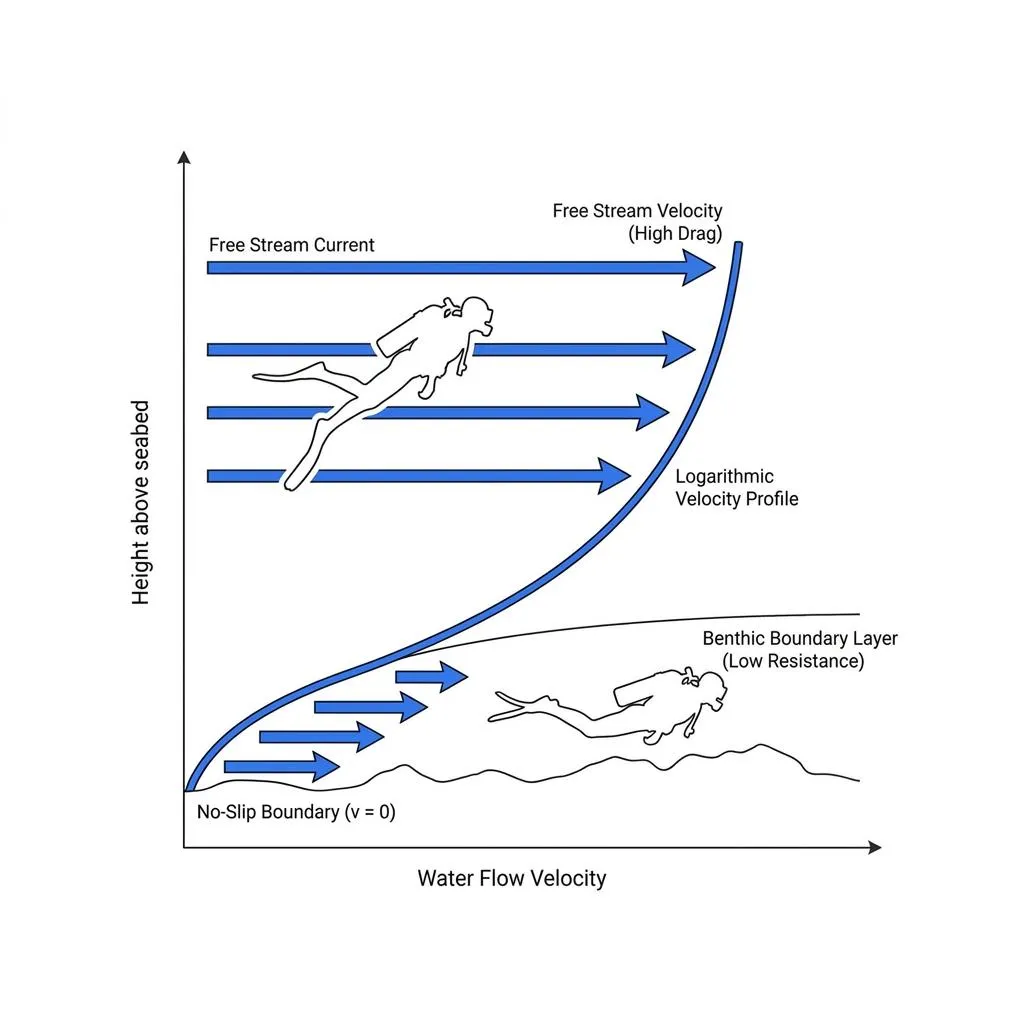
No matter how furiously a current rips through open water, fluid molecules in direct contact with the seabed come to a dead stop due to surface friction. This hydrodynamic no-slip condition creates a buffer zone extending several inches above the substrate, known in physical oceanography as the Benthic Boundary Layer.
Within this boundary layer, fluid velocity drops sharply along a logarithmic curve. While open water at a depth of 15 meters might rush past at an overwhelming 3 knots, dropping within 20 centimeters of a rough, rocky seabed reveals flow rates plummeting below half a knot. Hovering even a meter too high exposes a diver to the punishing free-stream current, whereas dropping into the boundary layer allows one to slip beneath the main force of the water.
When forced to swim up-current, the correct physical response is not to orient vertically and kick harder, but to lock into a flat horizontal trim and hug the seabed. This narrow friction zone provides the only viable physical haven for human divers seeking to bypass the immense kinetic energy of open currents.
Topographic Sanctuaries: Eddies and Flow Separation Zones
Just as a boulder in a rushing river creates calm water directly behind it, underwater seamounts and massive coral bommies trigger fluid dynamic flow separation.
As moving water strikes the windward face of an obstruction and spills around its perimeter, a low-pressure wake zone forms on the sheltered leeward side. Within this shadow zone, forward current stalls completely; in many cases, recirculating eddy currents form, gently pulling the diver forward toward the reef rather than sweeping them downstream.
Strategic divers navigate high-energy sites by leapfrogging between these topographic shelters. Resting on the leeward flank of a pinnacle allows divers to recover their breath and assess the route before executing short, decisive sprints across open gaps into the next protected eddy.
Trim Optimization and Fin Selection: Riding the Boundary
Descending into the benthic zone requires uncompromising technique to avoid environmental damage. Dropping down only to pedal vertically with a flutter kick destroys underwater visibility by launching silt clouds and thrusts fin tips into higher-velocity water layers above, neutralizing the boundary layer advantage.
Maintaining a locked horizontal trim reduces the diver's frontal surface area, nesting the entire body within the calmest lower tier of the boundary layer. Combining this orientation with a modified frog kick—keeping the knees bent at 90 degrees and articulating the ankles upward—allows divers to generate thrust from the stagnant water layer without impacting bottom sediment.
High-rigidity rubber jet fins are exceptionally effective in these conditions. Unlike soft recreational blades that deform under heavy cross-flows, stiff fins transfer muscle torque directly into forward propulsion, allowing divers to convert subtle pockets of calm water into efficient upstream momentum.
Currents Are Waves to Harness, Not Enemies to Fight
The world's most vibrant coral drop-offs and pelagic aggregation sites exist precisely because strong currents supply endless streams of nutrient-rich plankton. High current is not an environmental defect; it is the lifeblood of marine ecosystems.
Human musculature cannot outmatch millions of tons of moving water through brute force. Composure and safety in high-energy environments come from respecting fluid mechanics, hugging boundary friction zones, and slipping through topographic blind spots. When divers learn to read fluid vectors through an understanding of physics, currents cease to be terrifying obstacles and become the pathway to dynamic underwater exploration.