Upon returning to the boat or shore after a dive, logging the surface interval in a logbook is standard practice. Many divers look at this period simply as an intermission to relieve fatigue before the next plunge or as a vague gap to let nitrogen escape.
However, the true purpose of a surface interval centers on controlling a far more deceptive and dangerous entity: 'Silent Bubbles,' the primary trigger of decompression sickness. Understanding how the time spent on the surface functions as a scientific process to flush out the inside of blood vessels is critical for every diver.
From Dissolved Gas to Visible Bubbles
As pressure increases underwater, the nitrogen breathed from a cylinder dissolves cleanly into the blood and body tissues, conforming directly to Boyle's and Henry's laws. Nitrogen at this stage remains entirely in a liquid-dissolved state and causes no physiological issues. This replicates the behavior of a sealed carbonated beverage, where the liquid stays perfectly still and transparent before the cap is removed.
The shift occurs during ascent. As a diver moves closer to the surface, the surrounding ambient pressure drops, forcing the nitrogen dissolved within tissues to escape back into a gas state. Mirroring the way fine bubbles fizz up when a soda cap is twisted off, microscopic nitrogen bubbles begin forming within a diver's bloodstream and tissues. These tiny pockets of gas travel through the body without immediately triggering obvious decompression sickness (DCS) symptoms, earning them the name 'Silent Bubbles.'
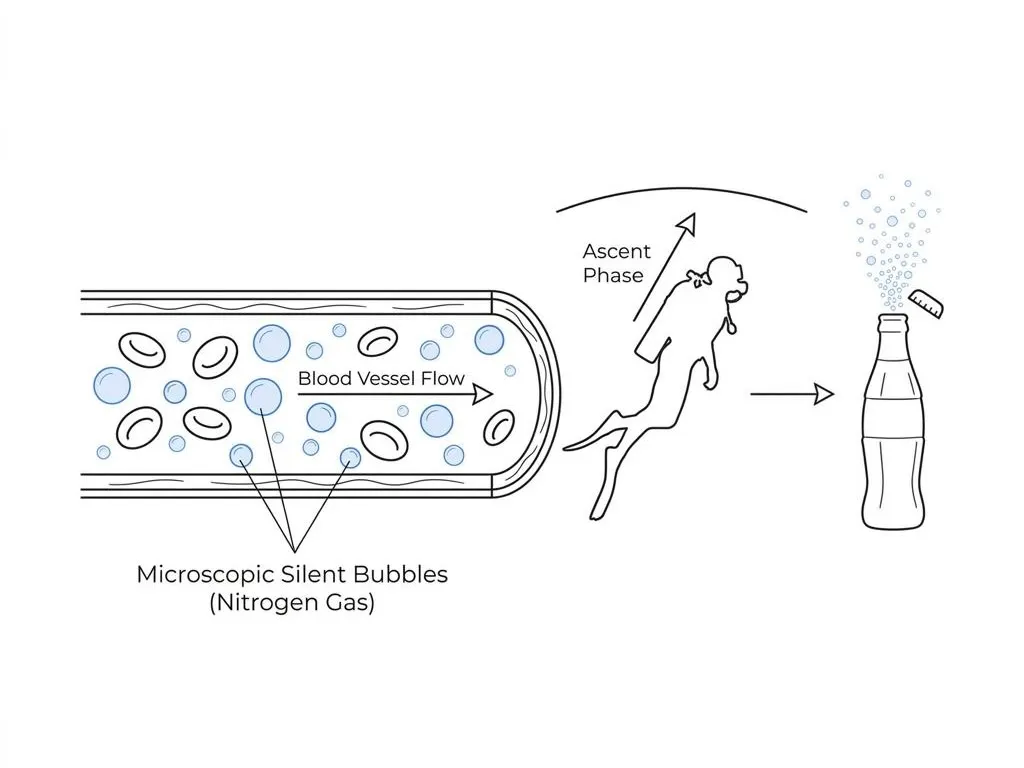
The Absence of Symptoms Does Not Equal Safety
Doppler ultrasound evaluations in hyperbaric medicine confirm that microscopic bubbles regularly appear in the bloodstream of healthy divers, even those who complete perfect safety stops and strictly follow conservative ascent rates. Because these bubbles remain tiny and sparse enough not to block blood flow immediately, a diver feels no joint pain or neurological numbness.
Yet, assuming these bubbles are entirely harmless is a dangerous mistake. Initiating a repetitive dive without an adequate surface interval while a high volume of silent bubbles remains in the system invites severe complications. As a diver descends and ascends during a second profile, newly dissolved nitrogen gas naturally migrates toward the pre-existing micro-bubbles, causing them to expand rapidly like a rolling snowball. These enlarged bubbles eventually obstruct capillaries, starving tissues of oxygen and manifesting as acute decompression sickness.
Surface Interval: Purging Bubbles Through the Lungs
A surface interval acts as an active cleansing window, utilizing the lungs as a natural filtration system to safely vent micro-bubbles out of the circulatory system.
Circulating through the bloodstream, silent bubbles eventually pass through the pulmonary architecture. The delicate alveolar membrane surrounding the lung air sacs serves as a specialized filter, trapping the micro-bubbles carried by the blood. Once caught, these nitrogen bubbles gradually diffuse across the membrane wall and break down, allowing them to be safely exhaled with every breath.
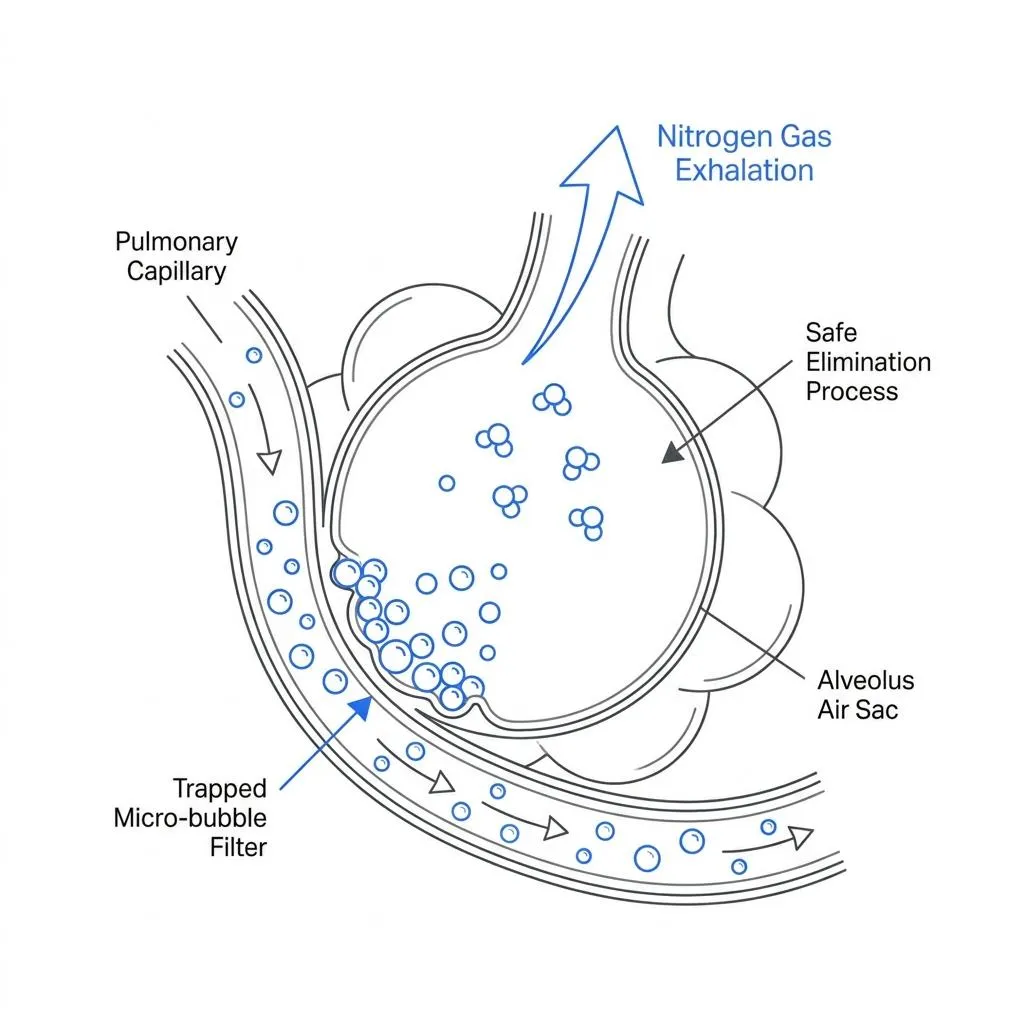
This entire purification process relies strictly on a fixed dimension of time. The rate at which gas diffuses across the alveolar boundary is dictated by physics and cannot be rushed. When a dive computer counts down the surface interval, it is essentially tracking how long this biological filtration system has been running.
Tactical Behaviors for Optimizing the Purge
To help the body cleanse silent bubbles with maximum efficiency, a diver must manage their surface interval strategically. The two most critical variables are hydration and thermal protection. Dehydration and hypothermia post-dive impair peripheral circulation, drastically slowing down the rate at which micro-bubbles travel to the lungs for elimination. Drinking adequate amounts of warm water and keeping the core warm directly optimizes the body's internal filtration performance.
A surface interval should never be viewed as dead time between dives; it is a dynamic extension of the decompression process. While resting on the surface, keeping in mind that the lungs are meticulously scrubbing the bloodstream clean provides a better perspective on safety. Respecting the time needed to thoroughly clear the system ensures that the subsequent dive remains a peaceful and secure exploration.