A dive computer is a highly intelligent machine on your wrist that calculates your safe dive time in real-time. However, you have probably noticed that your No Decompression Limit (NDL) can differ by several minutes from your buddy's, even when diving side-by-side at the exact same depth and time. Is this a mechanical error? Or is it a difference in the underlying models?
The answer lies in the "algorithm" embedded inside your dive computer. The computer logically divides your body into dozens of pieces, performing calculations every single second. In this article, we will uncover these mathematical secrets through the Bühlmann model, often considered the standard of modern dive computer algorithms.
Slicing Your Body into 16 Virtual Compartments
Your dive computer knows nothing about your actual blood type, body fat percentage, or muscle mass. Instead, it simulates your body by dividing it into 16 virtual compartments using a mathematical model (ZHL-16) developed by Dr. Albert A. Bühlmann.
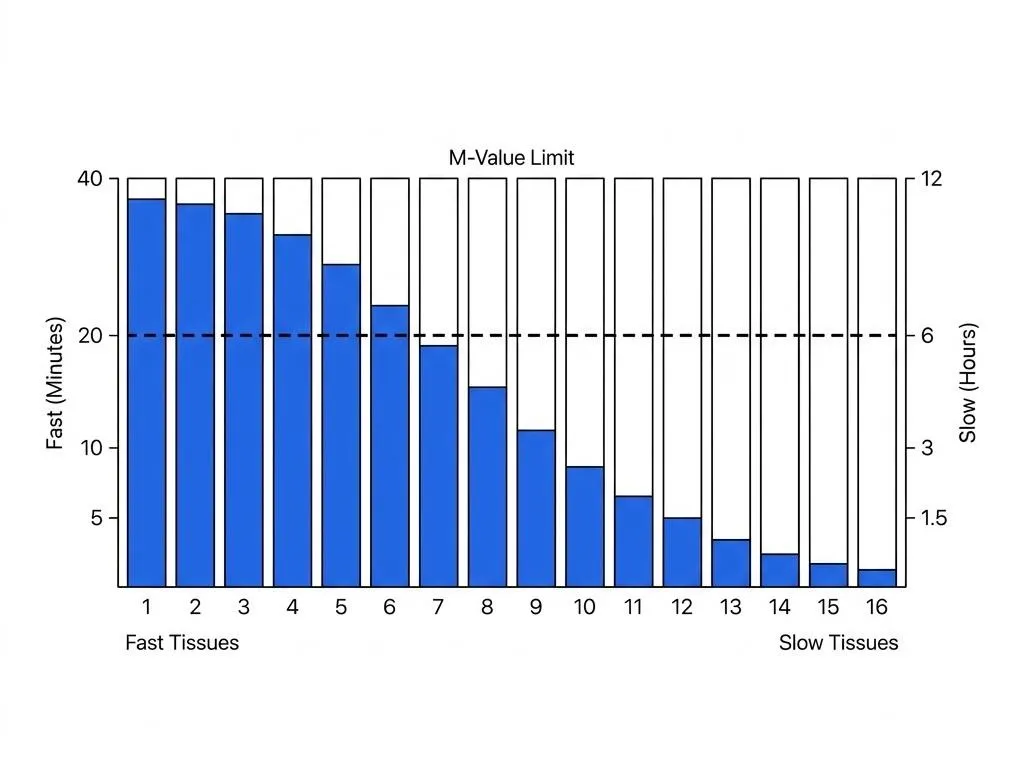
These 16 compartments range from fast tissues, like blood and the brain which have high blood flow and exchange gas rapidly, to slow tissues, like bone and cartilage which exchange gas very slowly. From the moment you descend underwater, the computer begins calculating in parallel exactly how much nitrogen each of these 16 virtual compartments is absorbing.
Half-Times and Nitrogen Saturation Rates
Each virtual compartment has its own unique rate of absorbing and releasing nitrogen. We explain this rate using the concept of Half-Time. A half-time is simply the time it takes to fill half the difference between the ambient pressure and the tissue's internal pressure.
For example, a fast tissue with a 5-minute half-time will suck in nitrogen instantly as you go deeper, but it will also off-gas just as quickly when you ascend. Conversely, a slow tissue with a 120-minute half-time absorbs almost no nitrogen during a brief stay at depth. However, if you do repetitive dives, nitrogen slowly accumulates in these slow tissues, and it does not easily dissipate even during your surface intervals. The single NDL number displayed on your computer screen is actually the final result of a fierce nitrogen saturation race happening among these 16 compartments in the background.
The Line of Survival: The M-Value
So, exactly how does the computer determine this NDL? In the Bühlmann model, each virtual compartment has an absolute limit set called the M-Value (Maximum Allowed Supersaturation). This represents the maximum threshold of nitrogen pressure that a compartment can withstand without forming microbubbles, which cause decompression sickness (DCS).
As your dive progresses, the time remaining until any single one of the 16 compartments reaches its specific M-Value is the NDL blinking on your screen. Generally, in deep dives beyond 30 meters, the fast tissues absorb nitrogen rapidly and drain your NDL. Conversely, during long, shallow dives, the intermediate or slow tissues that slowly accumulate nitrogen become the Leading Tissue that ultimately dictates your NDL.
The Decisive Reason Your NDL Differs From Your Buddy's
Now we can mathematically explain why your buddy's NDL differs from yours. The primary reason is the difference in the algorithms and conservatism settings adopted by each computer. A computer running the Bühlmann algorithm and another running the RGBM algorithm operate on completely different mathematical premises for calculating M-Values and predicting bubble growth. Furthermore, even within the same Bühlmann model, adjusting the conservatism setting—known as the Gradient Factor—drastically shifts the baseline where the computer cuts off your NDL.
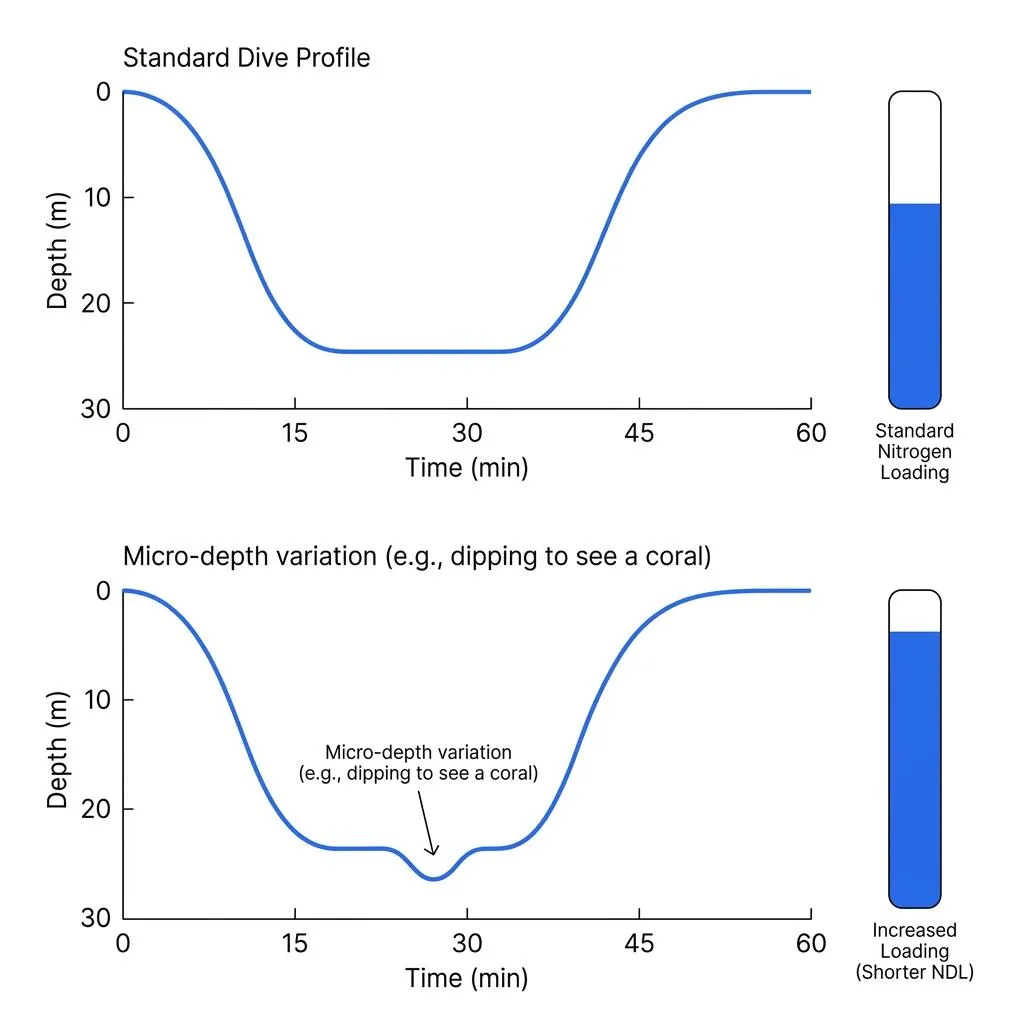
Even if you use the exact same dive computer with identical settings, your NDLs can still differ. Diving is not a perfectly synchronized three-legged race. If your buddy dipped one meter below you for just 30 seconds to look at a coral on the bottom, their fastest compartment #1 has already experienced more pressure and absorbed more nitrogen than yours. The computer's ultra-precise pressure sensor continuously tracks these microscopic depth variations and time accumulations second by second, penalizing your buddy's NDL by a minute or two before yours.
Understanding Beyond the Machine's Instructions
A dive computer is not a magical box. It is a precise calculator that constantly feeds real-time pressure data into a mathematical model to derive an answer. Once you understand the mechanics of the algorithm and the state of the 16 virtual compartments hidden behind the NDL digits on your screen, you evolve. You move beyond being a passive diver relying solely on machine alarms, gaining a higher level of perspective to proactively control and design your own dive profile.