environment

Zero Salinity Trap, Ballast Recalibration, and Fluid Dynamics

Preparing for Mexico Diving, The Hidden Truth of Freshwater Physics

29 August 2026

Because most divers complete their open water training in the ocean, their baseline understanding of underwater mechanics naturally revolves around marine environments. It is easy to assume that buoyant saltwater, predictable tidal flows, and expansive coral reefs represent the universal reality of diving.

However, venturing into freshwater environments—such as mystical Mexican cenotes, serene alpine lakes, or deep river basins—introduces abrupt and unexpected physical shifts. Divers entering freshwater with their standard ocean weight setups often plummet toward the bottom like an elevator in freefall or experience intense shock upon piercing razor-sharp thermoclines. Navigating freshwater safely requires dissecting the distinct physical laws and environmental nuances that separate lakes and caverns from the open sea.

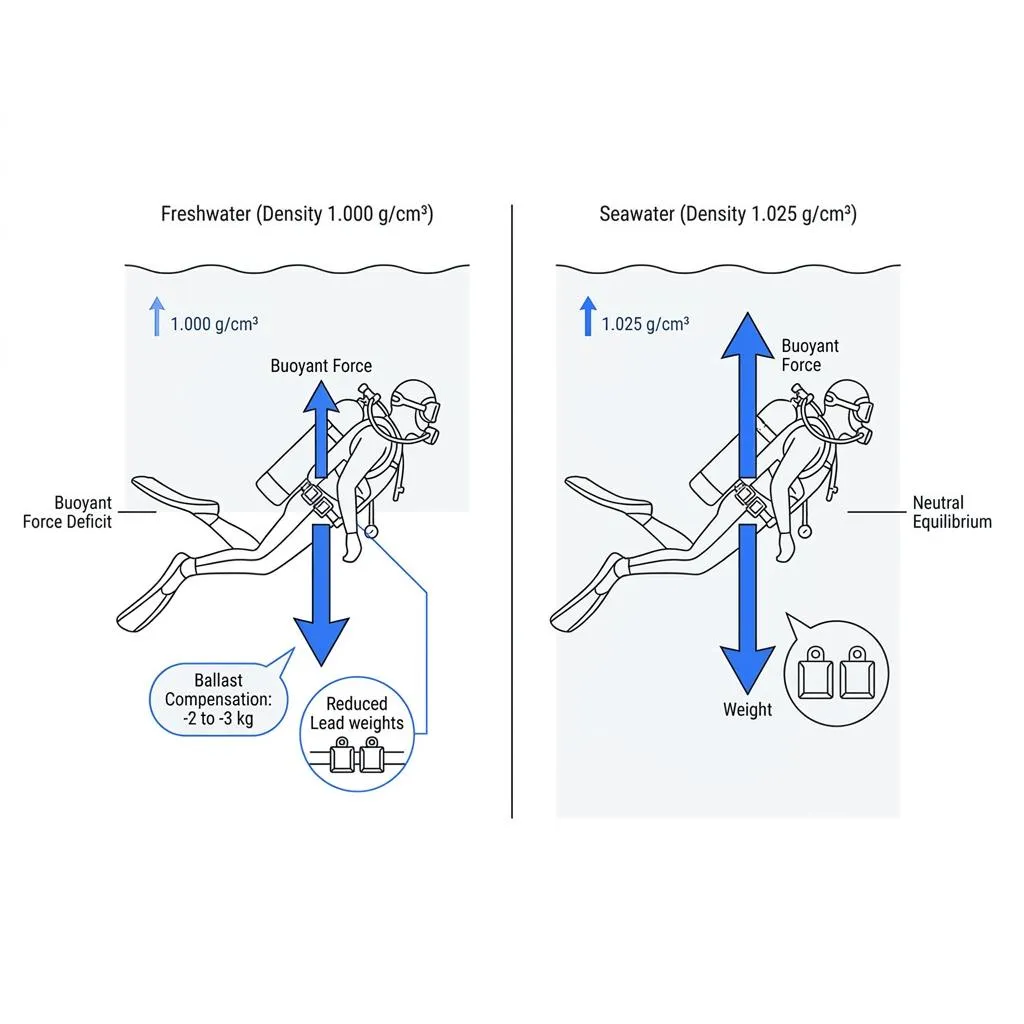
Freshwater vs Saltwater Buoyancy and Density Comparison / © Taehoon Kwon

Archimedes' Principle: How 3% Salinity Dictates Ballast

The first and most critical adjustment when transitioning to freshwater is recalculating ballast weight. Seawater contains an average salinity of 3.5%, making it roughly 2.5% to 3% denser than pure freshwater. While this density discrepancy might appear negligible on paper, it produces a massive shift in buoyant force when multiplied across the total displacement of a diver, exposure suit, and cylinder.

For a diver and equipment package displacing 100 liters of fluid, seawater generates 102.5 kg of buoyant lift, whereas freshwater yields only 100 kg. An ocean diver who enters a freshwater lake without adjusting ballast suddenly experiences 2.5 kg of immediate negative buoyancy—the equivalent of strapping an extra lead weight directly to the harness.

Before descending into freshwater, divers must conduct a proper buoyancy check and shed approximately 2 to 3 kg (roughly 2% to 3% of total body weight) from their standard ocean setup. Failing to adjust ballast leads to difficult surface swimming, rapid uncontrolled descents, and elevated risks of ear barotrauma or violent substrate impacts.

The Paradox of Extreme Clarity: Crystal Waters and the Silt Trap

Freshwater habitats, particularly groundwater filtered through subterranean limestone in cenotes or pristine high-altitude lakes, often deliver levels of water clarity rarely seen in the ocean. The near-total absence of suspended organic matter creates the sensation of hovering in midair, offering extraordinary panoramic visibility across tens of meters.

Yet beneath this optical perfection lies a severe operational hazard: bottom sediment. Unlike ocean floors that are continuously scrubbed by swells and tidal currents, stagnant lake beds and cavern floors accumulate thick layers of microscopic silt and organic decay over centuries. These particles are finer than talcum powder and react violently to the slightest fluid disturbance.

A single errant flutter kick can launch a massive silt cloud that remains suspended for hours due to the absence of flushing currents, reducing pristine visibility to absolute zero in seconds. Maintaining precise horizontal trim and deploying zero-downwash frog kicks are non-negotiable fundamentals when operating over delicate freshwater substrates.

Razor-Sharp Thermoclines and the Altitude Variable

While ocean waters experience continuous mechanical mixing that blends thermal layers gradually, enclosed freshwater systems form dramatic, unmixed thermoclines that resemble solid glass partitions underwater. A diver can descend through comfortable, sun-warmed water at 5 meters, only to pass through a distinct boundary layer into water ten degrees colder over the span of a few inches.

Furthermore, because freshwater reaches its maximum physical density at 4C4^\circ\text{C}, the bottom trenches of deep lakes remain locked in near-freezing, dense darkness year-round. Divers relying solely on surface temperature readings when selecting exposure protection risk severe hypothermia at depth.

Inland lakes also frequently reside at high elevations. Diving above 300 meters reduces ambient atmospheric pressure at the surface, which alters nitrogen off-gassing kinetics. Unless dive computers are switched to altitude mode and specific altitude decompression algorithms are applied, the risk of decompression sickness increases dramatically even at moderate depths.

Unlocking Underwater Time Capsules: The Enduring Appeal of Freshwater

While ocean diving centers primarily on dynamic marine biodiversity and coral reef interactions, freshwater exploration often resembles an archaeological and geological expedition into Earth's preserved history.

The absence of salt significantly retards the chemical oxidation of iron and organic degradation of wood. Shipwrecks and submerged aircraft that would rapidly corrode into heaps of rust in the ocean remain preserved in freshwater lakes for over a century, retaining their original woodwork and structural integrity. Intricate cave architectures, stalactites, and sculpted limestone formations offer visual landscapes found nowhere else on the planet.

By respecting the unique fluid dynamics of freshwater and adapting equipment configurations and buoyancy profiles accordingly, divers unlock a pristine, historically rich realm hidden far beyond the salty edges of the sea.