knowledge

Thermal Conductivity, Heat Capacity, and the Silent Threat of Underwater Hypothermia

Why Divers Turn Blue Even in 30°C Tropical Waters

8 September 2026

Divers traveling to tropical destinations frequently encounter a puzzling physiological reaction. Entering waters hovering near 30°C initially feels like slipping into a heated pool. Yet, after forty minutes of bottom time, divers frequently find themselves shivering uncontrollably during their safety stop, teeth chattering as cold seeps into their limbs.

On land, an atmospheric temperature of 30°C represents midsummer heat that induces sweating even while standing still. Experiencing deep, bone-chilling cold in water of the exact same temperature seems completely counterintuitive. This phenomenon is not driven by poor physical endurance, but by the unyielding thermodynamic properties of water clashing directly with the human body's evolutionary thermal limits.

Twenty-Five Times Faster: Water’s Thermal Conductivity and Infinite Heat Capacity

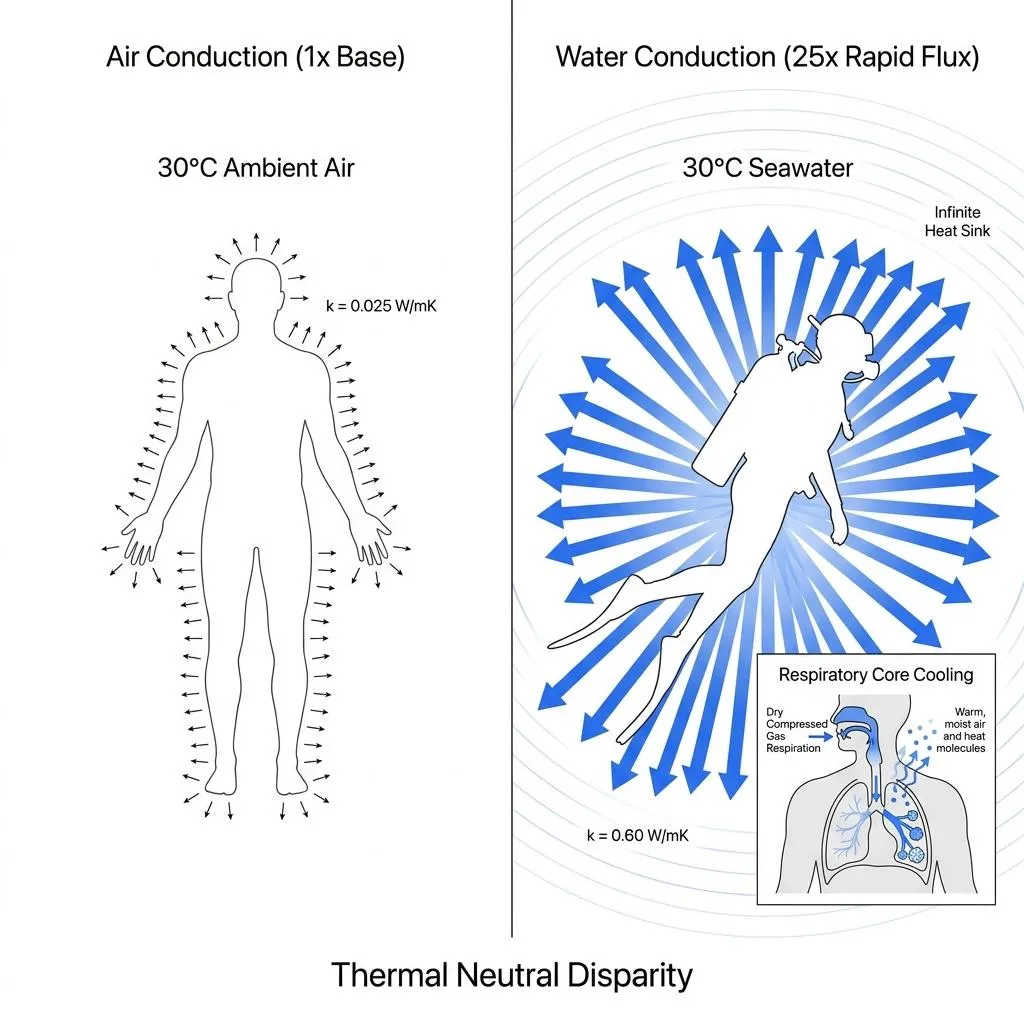
The primary driver of rapid in-water cooling lies in how water molecules absorb and transport thermal kinetic energy compared to atmospheric gases. From a fluid mechanics perspective, water possesses a thermal conductivity roughly 25 times greater than that of air. Under identical temperature gradients and surface areas, thermal energy conducts away from exposed skin into surrounding water 25 times faster than it does into open air.

This rapid transfer is magnified by volumetric heat capacity, a product of fluid density and specific heat. Water absorbs over 3,000 times more thermal energy per unit volume than air does. While ambient air touching skin quickly warms to form a boundary insulating layer, seawater rapidly absorbs dermal heat and disperses it into the wider environment through continuous fluid displacement.

Entering the ocean initiates an impossible thermodynamic contest: an individual attempting to warm an infinite oceanic heat sink with their internal caloric reserves. Even at 30°C, the water sits substantially below the core human temperature of 36.5°C, ensuring that body heat continuously drains into the surrounding sea.

The 35°C Paradox: Why Humans Cool in Seemingly Warm Water

On land, the human thermal neutral zone—the ambient temperature range within which an unclothed, resting body maintains thermal equilibrium without altering metabolic output—sits roughly between 24°C and 27°C. Within this window, basal metabolic heat production matches environmental heat dissipation.

Submerged in water, this thermal neutral threshold shifts abruptly upward to between 34.5°C and 35.5°C due to aggressive convective and conductive heat transfer. Consequently, whenever a diver enters water below 35°C, the body immediately begins running a thermal deficit, initiating an inevitable cooling cycle.

A resting human produces merely 80 to 100 watts of metabolic heat, comparable to a single incandescent bulb. Seawater at 30°C extracts thermal energy at rates that vastly outstrip this modest production. Vigorously kicking or sculling to generate heat actually worsens the deficit, as movement accelerates water turnover across the skin and increases convective cooling.

Heat Loss Mechanisms / © Taehoon Kwon

Respiratory Heat Drainage: Internal Alveolar Cooling from Dry Gas

Dermal conduction accounts for only part of total bodily heat loss. The compressed gas inhaled continuously from a scuba cylinder acts as a stealthy, internal heat extractor operating deep within the thoracic cavity.

As high-pressure gas expands through the first and second stages of a regulator, adiabatic expansion (the Joule-Thomson effect) drops the breathing gas temperature considerably. Furthermore, compressor filtration strips this gas of virtually all moisture. When this bone-dry, cool air reaches the pulmonary alveoli, the respiratory lining must continuously humidify and warm every breath to internal body temperature, evaporating precious bodily heat and water.

Because internal thermal reserves are stripped directly from the lung core with every respiratory cycle, core body temperature inevitably drifts downward over extended dive times, regardless of the thermal rating of the diver's exposure suit.

Silent Hypothermia and Decompression Stress

Thermal depletion causes more than physical discomfort; it sets off a cascading physiological hazard chain that undermines dive safety. To shield vital organs, the body executes peripheral vasoconstriction, drastically restricting blood circulation to the limbs. This response dulls tactile finger sensitivity, impairs gear operation, and diminishes cognitive situational awareness during critical underwater emergencies.

Even more critical is the direct link between hypothermia and decompression sickness (DCS). As peripheral blood vessels constrict toward the end of a dive, the rate of blood flow through muscular and joint tissues plummets, severely impairing the off-gassing of dissolved inert nitrogen. Divers ascending with cold, under-perfused peripheral tissues retain higher inert gas loads, significantly elevating DCS risk during and after the safety stop.

Because this condition frequently progresses without violent shivering, diving medicine terms it "silent hypothermia." Experiencing severe post-dive exhaustion, joint stiffness, or mild mental fog after a dive in warm water indicates that the body's internal core was compromised by unchecked heat drainage.

The Science of Wetsuits: Converting Water into Insulation

Given that water strips heat 25 times faster than air, extended submerged dives are possible only by using the material science built into modern exposure protection: closed-cell neoprene foam.

When donning a wetsuit and descending, a micro-layer of water seeps inside and settles against the skin. The tight seals of the suit prevent this fluid layer from circulating out into the ocean. Once the diver's skin warms this trapped film of water, it ceases to circulate, functionally transforming a potential convective heat sink into a stationary, highly effective thermal barrier.

Wetsuit effectiveness depends as much on tailored, flush-free fit as it does on material thickness. Forgoing exposure protection for a loose rash guard in 30°C water exposes a diver directly to the aggressive physics of thermal conduction, inviting silent hypothermia into what should be an effortless tropical dive.