knowledge

Light Refraction and Color Extinction

Why Underwater Photos Look Blue

24 July 2026

When entering the ocean with an underwater camera or a smartphone housing, divers frequently encounter a frustrating outcome: the brilliant, vivid colors of soft corals and tropical fish observed by the naked eye appear washed out, covered in a dull, monochromatic shade of blue or blue-green in captured images. Yet, the moment an external strobe or video light illuminates the exact same scene, vibrant reds and golds magically burst back to life. The blue underwater realm we perceive with our eyes is, in reality, a "false color" illusion generated by the ocean acting as a massive liquid filter. We dissect the precise physical mechanisms of light absorption and refraction behind this optical transformation.

The Law of Wavelengths: Visual Extinction Starting from Red

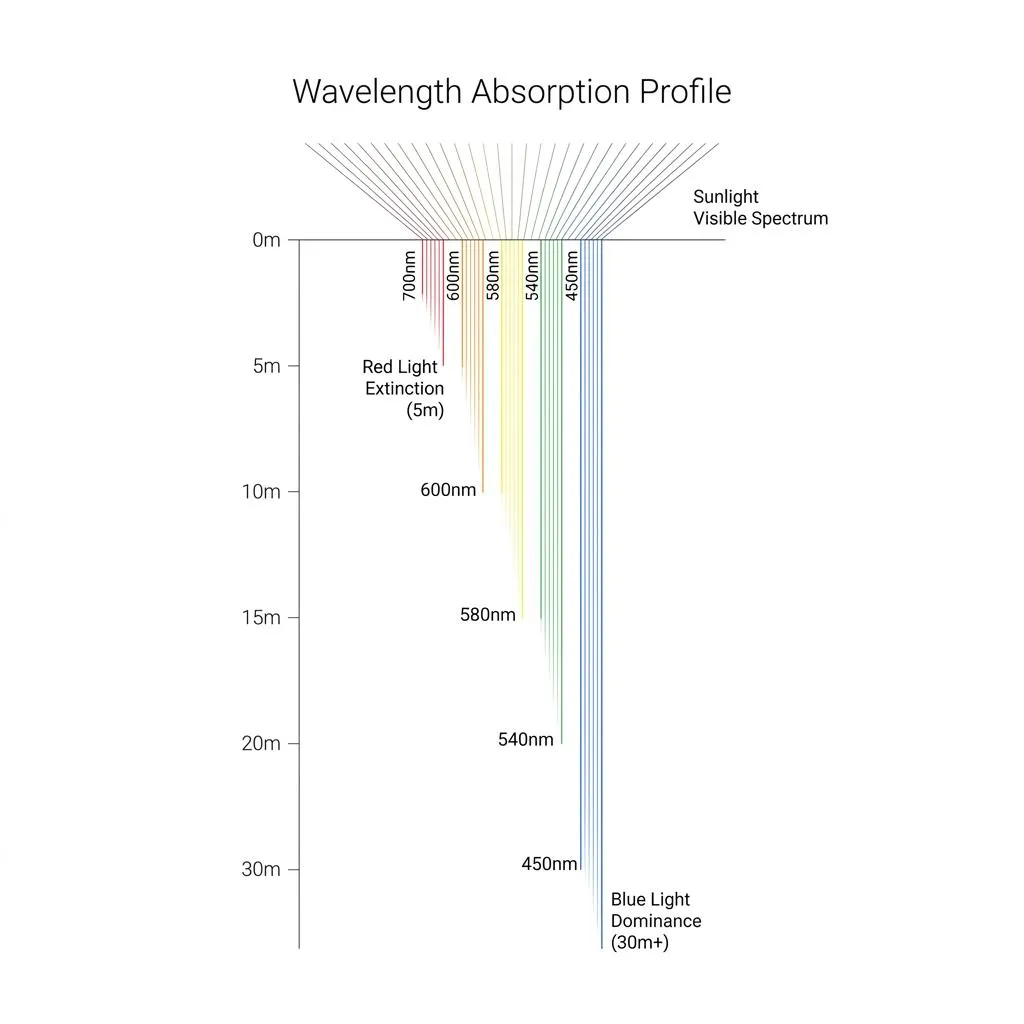
Sunlight comprises a spectrum of visible light wavelengths. Within this visible spectrum, longer wavelengths corresponding to the red region (approximately 650–700 nm) possess lower photon energy, whereas shorter wavelengths corresponding to violet and blue (approximately 400–480 nm) carry significantly higher energy levels.The instant sunlight penetrates the water surface, water molecules and suspended particulate matter selectively absorb light, starting with the longer, lower-energy wavelengths:

- 5 Meters Depth: Over 90% of red light wavelengths are absorbed and eliminated. Below this depth, even human blood loses its crimson hue, appearing dark brown or dull green.10 Meters Depth: Orange wavelengths decay and vanish from the spectrum.
- 15–20 Meters Depth: Yellow and green wavelengths are sequentially absorbed. - 30 Meters and Beyond: Only the shortest, highest-energy blue wavelengths penetrate and scatter through the water column.

The Loss of Color Spectrum at Different Depths / © Taehoon Kwon

Consequently, any subject viewed at a depth of 20 meters without artificial illumination reflects only the remaining filtered blue light, as red and orange photons no longer exist in the ambient environment. An underwater photograph appears monochromatic blue not because of sensor inadequacy, but because the red light needed to reflect off the subject has already been stripped away by the water column.

The Trap of Path Length: Why Reds Fade Even at 3 Meters

A common misconception among divers is that red colors remain fully intact at shallow depths, such as 3 meters. In underwater optics, however, the critical variable is not depth alone, but the Total Path Length traveled by the light.

Sunlight travels 3 meters down from the surface to hit a subject at a 3-meter depth. The light then reflects off the subject and travels another 3 meters through the water column to reach the diver's eye or camera lens. Thus, the total distance light traverses through the aquatic medium is 6 meters—double the actual depth. As the distance between the camera and the subject increases, the path length expands, causing red light to degrade rapidly even in shallow water. This optical reality explains why underwater photographers prioritize extreme close-up shots (Macro / Wide Close-Up) to minimize path length and preserve natural color saturation.

The Magic of Refraction: Objects Appear 33% Larger and 25% Closer

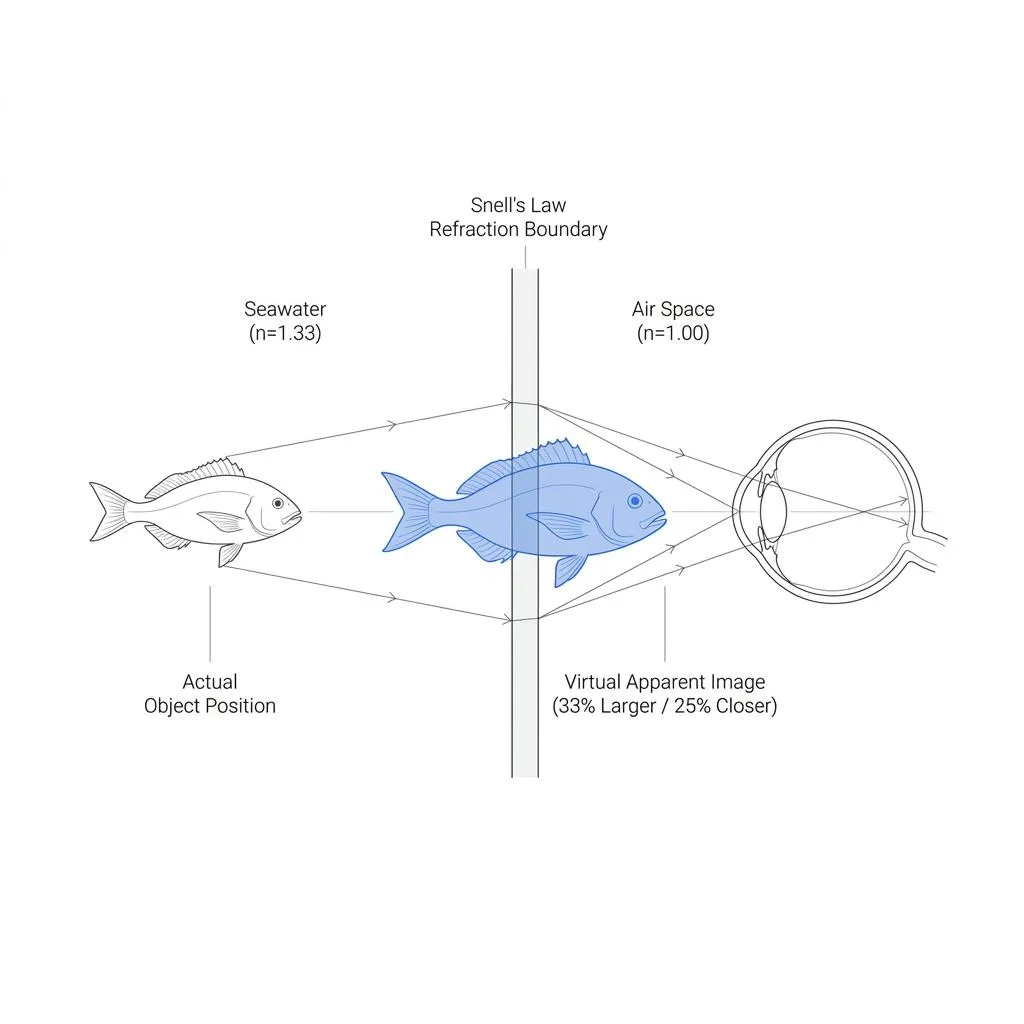
Alongside color extinction, light refraction represents another optical phenomenon that alters underwater perception. Light alters its speed depending on the density of the medium it traverses; the refractive index of seawater (approximately 1.33) is substantially higher than that of air (approximately 1.00).

As light travels through seawater, passes through the flat glass of a dive mask, and enters the air space inside the mask, it bends at the boundary interface due to the variance in optical density. Governed by Snell's Law, this refraction causes the human brain to perceive subjects as closer and larger than their true physical dimensions.

Magnification Factor=Refractive Index of Water (1.33)Refractive Index of Air (1.00)1.33\text{Magnification Factor} = \frac{\text{Refractive Index of Water (1.33)}}{\text{Refractive Index of Air (1.00)}} \approx 1.33

By virtue of this 1.33 magnification ratio, underwater objects appear roughly 33% larger and 25% closer than they actually are. This 33% refractive illusion explains why a diver reaching for a rock face finds it slightly further away than expected, or why a shell retrieved from the sea floor appears strikingly smaller once brought above the surface.

Refraction of Objects Seen Through a Dive Mask / © Taehoon Kwon

Reclaiming the Hidden Spectrum

The clear, serene blue world encountered during a dive is an altered visual reality where more than half of the solar spectrum has been filtered out. Understanding these physical constraints equips divers with a deeper, more analytical perspective on the marine environment.

Minimizing shooting distances and utilizing artificial strobes to resurrect the lost spectrum trapped decades beneath the surface is more than photography—it is a scientific restoration of the ocean's true colors. By mastering the laws of wavelength absorption and optical refraction, divers look past underwater visual illusions to appreciate the authentic, hidden spectrum of the deep.